A client sat in my chair last month with two-year-old locs and one question: "The internet says I only need to tighten them every three or four months. Why do mine look like this?"
The answer was not her fault. It was her sources.
Almost everything written about dreads in Polish is about a different hairstyle. Search "pielęgnacja dredów" and the advice you find (tighten every 2 to 4 months, regeneration for 100 to 200 zł) comes from studios that crochet synthetic or European straight hair into dreads. That is real craft, but it is a different craft. Natural Afro locs form and grow by a different mechanism, and they live on a different schedule.
Why Afro locs run on a faster clock
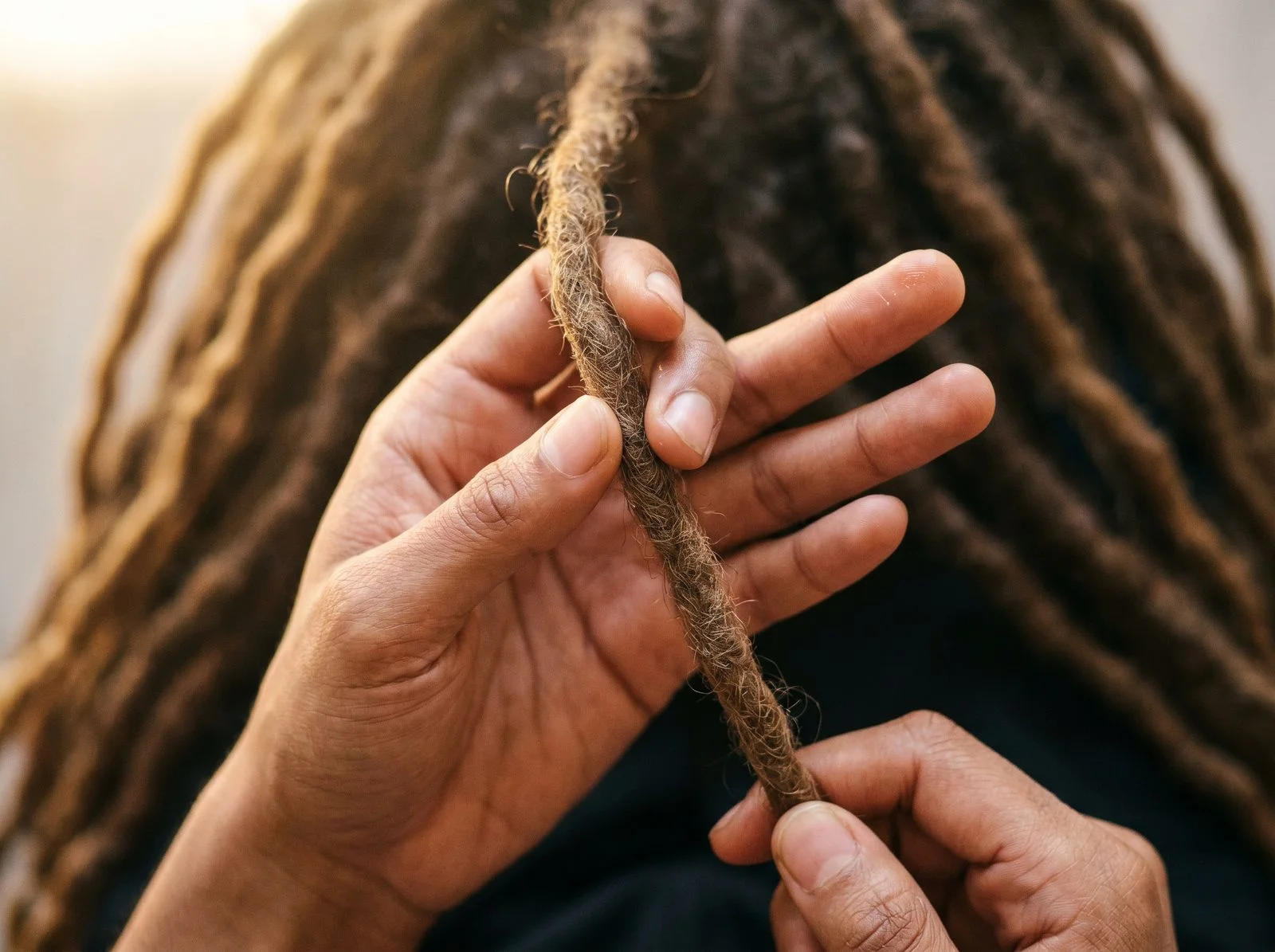
Afro-textured hair locks because the coil pattern lets strands mat and fuse into a solid unit. The loc itself, once mature, is stable. The vulnerable part is the new growth: the fresh, loose hair between your scalp and the start of the loc.
That new growth appears every week your hair grows. Leave it too long and three things happen:
- Neighbouring locs marry. Loose new growth from one loc mats into the loc next door. Separating married locs months later means cutting or ripping.
- The root thins. An unmanaged loc gets heavier at the length while staying loose at the base. The weight hangs on a thinning anchor point, and locs that snap almost always snap there.
- Buildup calcifies. Warsaw's hard water deposits minerals into the loose root section, where they harden inside the forming loc. We wrote about the mechanism in our Hard Water Survival Guide.
The actual schedule
For natural Afro locs, retouching every six to eight weeks keeps the root tidy, the rows separated, and the anchor strong. That is the bi-monthly rhythm, not the quarterly one that synthetic-dread advice suggests.
A retouch at The V (Dreadlock Retouching, from 350 zł) is not just twisting. It is separation of any locs starting to marry, root work with the correct tension for your density, and a check of the ten or so locs at your crown and temples that carry the most stress.
What neglect actually costs
Here is the math nobody shows you. Skip retouching for six months and the fix is no longer a 350 zł appointment. Married locs need surgical separation. Thinned roots may need combining or, in the worst case, cutting the loc. A deep Dreadlock Detox (from 200 zł) becomes mandatory rather than optional. A neglected year can easily end in a 1,000 zł reconstruction, or in locs that cannot be saved.
Regular maintenance for a full year (six retouches plus two detox washes) adds up to about 2,500 zł at menu prices. Our Loc Maturity Plan covers exactly that first-year cycle, installation included, for 2,700 zł prepaid, and Loc Year Two continues the rhythm at 2,050 zł. The plans exist because the schedule matters more than any single appointment.
The V Verdict: If your advice about locs came from a site that also sells synthetic dreads, it was written for hair that does not behave like yours. Afro locs are maintained at the root, every six to eight weeks, by someone who knows what a healthy root feels like.
W zeszłym miesiącu na moim fotelu usiadła klientka z dwuletnimi dredami i jednym pytaniem: „Internet mówi, że wystarczy je dokręcać co trzy, cztery miesiące. Dlaczego moje tak wyglądają?"
Odpowiedź nie leżała po jej stronie. Leżała po stronie jej źródeł.
Prawie wszystko, co napisano po polsku o dredach, dotyczy innej fryzury. Wyszukaj „pielęgnacja dredów", a porady, które znajdziesz (dokręcanie co 2 do 4 miesięcy, regeneracja za 100 do 200 zł), pochodzą ze studiów, które szydełkują dredy z włosów syntetycznych lub prostych europejskich. To prawdziwe rzemiosło, ale inne rzemiosło. Naturalne dredy afro powstają i rosną w inny sposób i żyją według innego kalendarza.
Dlaczego dredy afro chodzą na szybszym zegarze
Włosy afro filcują się w dredy, bo skręt włosa pozwala pasmom spleść się i zrosnąć w jednolitą całość. Sam dojrzały dred jest stabilny. Wrażliwym miejscem jest odrost: świeże, luźne włosy między skórą głowy a początkiem dreda.
Ten odrost pojawia się w każdym tygodniu wzrostu. Zostaw go zbyt długo, a wydarzą się trzy rzeczy:
- Sąsiednie dredy się zrastają. Luźny odrost jednego dreda wplata się w dreda obok. Rozdzielanie zrośniętych dredów po miesiącach oznacza cięcie albo rozrywanie.
- Nasada się przerzedza. Zaniedbany dred robi się coraz cięższy na długości, pozostając luźny u podstawy. Cały ciężar wisi na coraz cieńszym punkcie zaczepienia. Dredy, które się urywają, prawie zawsze urywają się właśnie tam.
- Osad twardnieje. Warszawska twarda woda odkłada minerały w luźnej sekcji przy nasadzie, gdzie zastygają wewnątrz formującego się dreda. Mechanizm opisaliśmy w naszym Przewodniku po twardej wodzie.
Właściwy harmonogram
Dla naturalnych dredów afro retusz co sześć do ośmiu tygodni utrzymuje porządek u nasady, oddzielone rzędy i mocne zakotwiczenie. To rytm dwumiesięczny, a nie kwartalny, który sugerują porady o dredach syntetycznych.
Retusz w The V (Dreadlock Retouching, od 350 zł) to nie tylko dokręcanie. To rozdzielenie dredów, które zaczynają się zrastać, praca u nasady z napięciem właściwym dla Twojej gęstości i kontrola tych około dziesięciu dredów na czubku głowy i skroniach, które niosą największe obciążenie.
Ile naprawdę kosztuje zaniedbanie
Oto rachunek, którego nikt nie pokazuje. Odpuść retusz na pół roku, a naprawa przestaje być wizytą za 350 zł. Zrośnięte dredy wymagają chirurgicznego rozdzielania. Przerzedzone nasady trzeba łączyć, a w najgorszym razie dreda ściąć. Głęboki Dreadlock Detox (od 200 zł) staje się koniecznością, a nie opcją. Zaniedbany rok potrafi skończyć się rekonstrukcją za 1000 zł albo dredami, których nie da się uratować.
Regularna pielęgnacja przez cały rok (sześć retuszy plus dwa mycia detoksykujące) to według cennika około 2500 zł. Nasz Plan Dojrzewania Dredów obejmuje dokładnie ten pierwszy roczny cykl, razem z instalacją, za 2700 zł z góry, a Dredy: Rok Drugi kontynuuje ten rytm za 2050 zł. Te plany istnieją, bo harmonogram znaczy więcej niż pojedyncza wizyta.
Werdykt The V: Jeśli Twoje porady o dredach pochodzą ze strony, która sprzedaje też dredy syntetyczne, były pisane dla włosów, które nie zachowują się jak Twoje. Dredy afro pielęgnuje się u nasady, co sześć do ośmiu tygodni, u kogoś, kto wie, jak powinna wyglądać zdrowa nasada.